
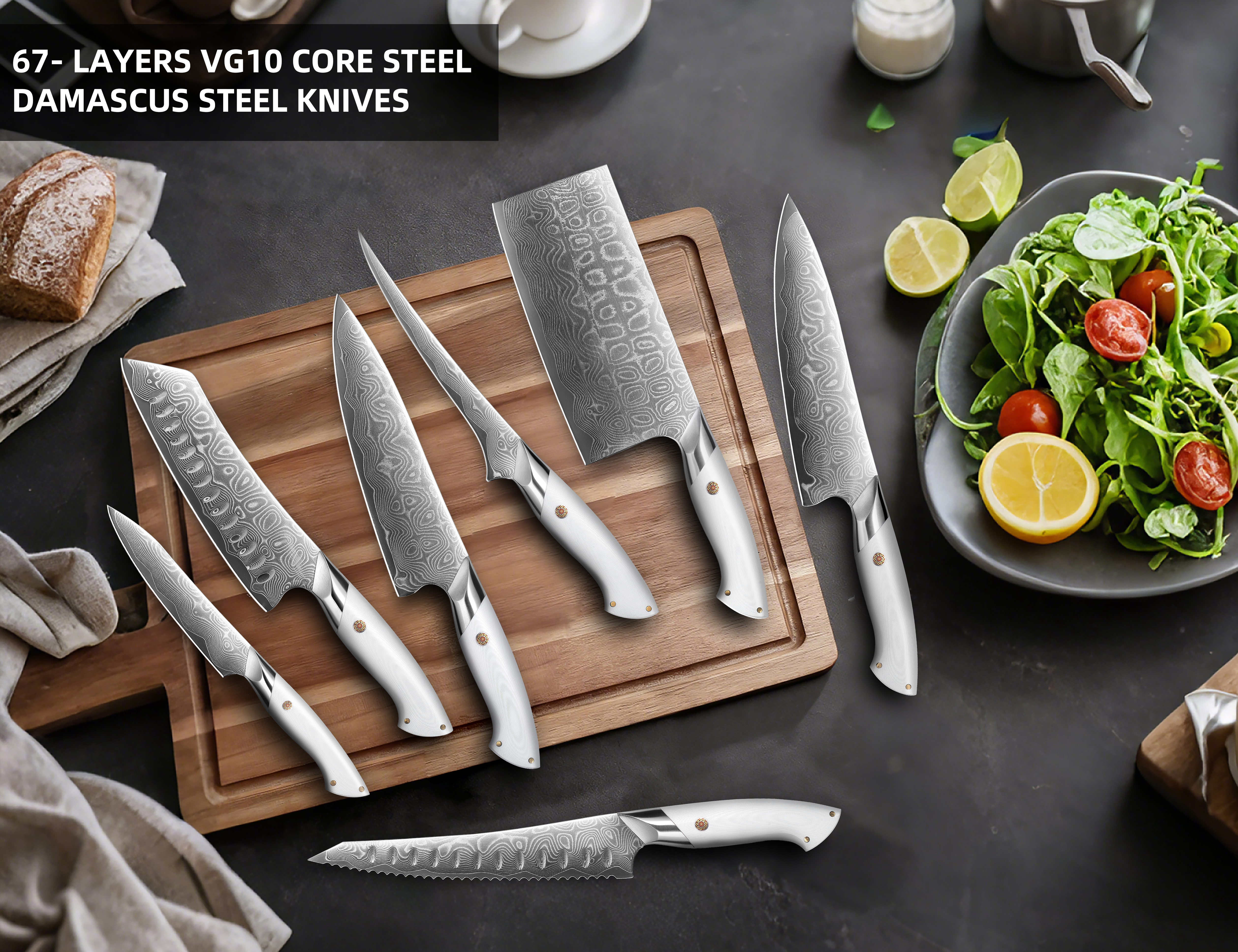
**From Forge to Finish: The Fascinating Journey of a Damascus Knife**
Few blades capture the imagination quite like the Damascus knife. Known for its mesmerizing patterns, legendary sharpness, and enduring strength, the Damascus knife is more than just a kitchen tool or collector’s piece—it’s a testament to centuries of metallurgical artistry and tradition. In this blog, we’ll take you through the captivating journey of a Damascus knife, revealing each step in its transformation from raw steel to a finished masterpiece.
---
The Myth and History of Damascus Steel
The story of Damascus steel is woven with legend. Ancient warriors prized these blades for their ability to slice through nearly anything, attributing almost mythical qualities to their strength and sharpness. True Damascus steel, believed to originate from the Middle East as early as 300 AD, was shrouded in secrecy for centuries. The “lost art” of forging Damascus steel mystified metallurgists for generations, and the original process faded with time.
Modern Damascus steel, however, revives the tradition by mastering modern techniques to produce blades that are both functionally superior and visually striking. Today, blacksmiths use multiple layers of steel, folded and forged together, to create the characteristic wavy or watery patterns. It’s this unique combination of beauty, durability, and history that makes Damascus knives so sought after.
---
Selecting the Raw Materials
The journey of a Damascus knife begins with careful selection of raw materials. The foundational steels used often include high-carbon varieties such as 1095, 15N20, or similar alloys. Blacksmiths might choose two or more types of steel with contrasting properties: one that’s tough and flexible, and another that’s hard and edge-retentive.
Quality matters at this stage—impurities or inconsistencies can ruin the pattern or render the knife brittle. The chosen steels are cut into precise strips or plates, cleaned thoroughly, and prepared for stacking. This initial step paves the way for the forging process, where the true alchemy begins.
---
The Forging Process
With the raw materials ready, the bladesmith stacks alternating layers of steel, often numbering from a few dozen to hundreds. These stacked layers—called a billet—are heated to an intense red-orange glow in a forge. Using a hammer or hydraulic press, the layers are forge-welded together under extreme pressure.
The magic of Damascus arises from folding and drawing out the billet multiple times. Each fold multiplies the layers, enhancing the intricate pattern. For example, a billet folded six times transforms 10 layers into 640! By strategically twisting, cutting, and re-stacking the steel, skilled blacksmiths can create specific designs—raindrop, ladder, or chevron patterns among the most popular.
The forging process is not just about appearance. It ensures that the properties of the different steels merge, combining toughness with the ability to take a razor-sharp edge. This is the foundation on which the rest of the knife is built.
---
Shaping and Grinding the Blade
After achieving the desired layer count and pattern, the billet is drawn out and shaped into the profile of the knife. This stage is both technical and artistic—each grinder’s hand brings a different flow to the blade’s silhouette.
Blacksmiths first mark and rough-cut the outline, then move on to grinding. The edge geometry is shaped, thinning the steel carefully to create a balance between sharpness and resilience. Any excess material is removed, and imperfections are meticulously ground out. The result is a blade that begins to resemble its final form.
---
Heat Treatment and Tempering
Heat treatment is a critical and delicate stage. The blade is heated in the forge to a precise temperature and then quenched—rapidly cooled, often in oil—to harden the steel. Quenching locks the steel's crystalline structure, producing a blade that retains its edge.
But a blade that is too hard can be brittle, so tempering follows. The blade is reheated to a lower temperature and allowed to cool slowly, which balances hardness with flexibility. This process demands expert timing and experience; even a small miscalculation can ruin a week’s work.
---
Revealing the Damascus Pattern
A Damascus knife's most enchanting feature is its flowing, organic pattern. This design is revealed during etching. The blade is cleaned and dipped in an acid bath, which reacts differently with each type of steel, etching light and dark areas that highlight the many layers. Makers may enhance the contrast with polishes or dyes, sharpening the dramatic effect.
Patterns can be as simple as random waves or as complex as customized mosaics. They’re not just for show—these patterns tell the story of the knife’s forging, a unique fingerprint that no two blades share.
---
Crafting the Handle
With the blade finished, attention turns to the handle. Great care goes into selecting materials: stabilised exotic woods, polished horn, durable synthetics, and even intricate inlays. The handle must be beautiful, ergonomic, and durable.
Handle scales are shaped and fitted, often using pins or adhesives for secure attachment. Craftsmen consider the balance of the knife, the feel in the hand, and the visual harmony with the blade’s pattern. Artistic flourishes, such as mosaic pins or custom engravings, may be added for a personalized touch.
---
Final Assembly and Finishing Touches
The last steps bring out the full potential of a Damascus knife. The entire knife is polished to a gleaming finish, and the edge is honed to razor sharpness. Makers perform rigorous quality checks, ensuring there are no flaws, uneven grinds, or structural weaknesses.
Some knives receive a protective coating to resist corrosion, while others are left with a natural finish, relying on regular care. Each completed Damascus knife is a tribute to hours—sometimes days—of labor, artistry, and craft.
---
Caring for a Damascus Knife
Owning a Damascus knife is owning a piece of living history. To keep your blade at its best:
- **Clean and dry immediately after use:** Damascus steel can rust if neglected.
- **Use food-safe mineral oil:** This helps prevent oxidation and keeps the pattern vivid.
- **Sharpen with a whetstone:** Maintain the edge carefully, avoiding electric grinders that might ruin the heat treatment.
- **Store in a dry place:** Avoid leather sheaths for long-term storage, as they can attract moisture.
- **Avoid harsh detergents:** Simple soap and water will suffice.
Treating your knife with respect ensures it will last a lifetime—and grow more beautiful with age.
---
Conclusion
From its legendary origins to modern workshops, the Damascus knife is a marvel of history, science, and art. Every step, from layering raw steel to revealing the final pattern, is an homage to generations of craftsmanship. Whether you’re a chef seeking the perfect kitchen tool, a collector searching for a unique work of art, or simply an admirer of fine craftsmanship, the journey of a Damascus knife is as captivating as the blade itself.
Looking to own a piece of history? Discover Damascus knives and experience the blend of tradition, performance, and beauty that has entranced knife enthusiasts for centuries.